
From the edge of La Jolla Cove, you can sometimes spot a faint golden-brown shimmer just below the surface, the tips of giant kelp reaching for the light. Below lies one of the most complex and productive marine ecosystems on the California coast, and for divers willing to suit up in cold Pacific water, it’s one of the country’s most rewarding dives.
This guide explains what makes La Jolla’s kelp forest distinctive, how its ecosystem is structured, when conditions are best, and what to realistically expect on your first descent through a kelp canopy.
What Makes La Jolla’s Kelp Forest Unique
La Jolla sits above one of the two largest kelp beds on the U.S. West Coast. Together with Point Loma to the south, the La Jolla forest stretches across nearly 19 square kilometers of protected nearshore habitat, a scale that puts it in rare company globally. Here, the kelp is giant kelp (Macrocystis pyrifera), the largest algae species on Earth. Under ideal conditions, a single strand can grow up to two feet per day, rising from a rocky holdfast on the reef floor to the surface canopy.

The forest also benefits from its status inside the San Diego–La Jolla Underwater Park, a protected ecological reserve that has kept commercial fishing and collection out of the area for decades. That protection helps explain why the fish here are larger and more approachable than at unprotected sites. A large black sea bass hanging motionless in the kelp midwater, watching you the way you’re watching it, is far more common in a reserve than outside one.
How the Forest Is Structured
A kelp forest isn’t a single, uniform environment; it’s a vertical ecosystem with distinct layers, each with its own residents. Understanding this structure changes how you experience the dive.
At the bottom is the benthic zone: the rocky reef and sandy substrate where holdfasts anchor each kelp stalk. Here, horn sharks and bat rays rest, spiny lobsters move at night, and purple urchins, the kelp forest’s primary grazers, graze along the reef. It’s also where most nudibranchs and encrusting invertebrates are found, so this layer rewards slow, close-focus diving.
Above the reef is the mid-water column, where the kelp stipes, or stalks, rise from the floor. This is the forest interior, where most of the fish life concentrates. Kelp bass, sheephead, rockfish, opaleye, and senoritas move through the stipes in loose aggregations. Garibaldi, California’s bright orange state fish, are impossible to miss here. Sea lions pass through this zone freely, turning and looping around the stalks with an agility that makes watching them through a full column of kelp feel genuinely surreal.
The canopy zone sits at or just below the surface, a dense ceiling of kelp fronds that filters light into shifting green-gold shafts as you look up from below. On clear summer mornings, divers describe this light effect as the “cathedral effect”: rays of sunlight cut through the canopy at angles that illuminate the water column like stained glass illuminates a church interior. It’s one of the more visually memorable moments available in Pacific Coast diving.
Visibility and Best Seasons
Visibility in the La Jolla kelp forest varies, so it’s worth understanding before you plan a trip. Visibility averages 15 to 20 feet on a typical shore dive, but conditions vary widely by season and surface conditions.
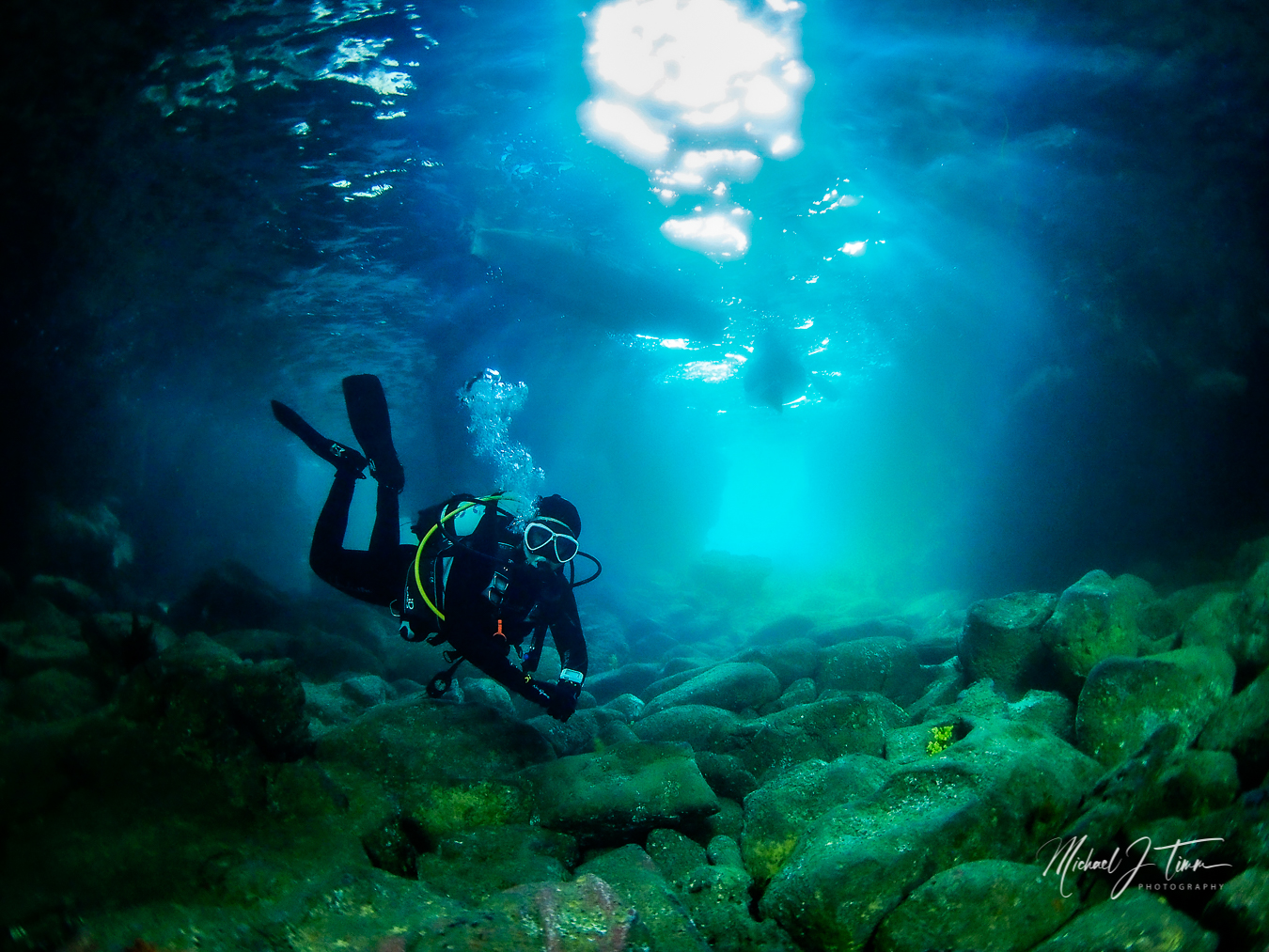 Late summer and early fall, July through October, tend to produce the clearest water. Winds are lighter, surface swell is reduced, and the plankton blooms that cloud the water in late spring have largely subsided. This is the window when you’re most likely to drop into 25 to 30 feet of visibility and get the light angles needed for the canopy effect to show.
Winter and early spring bring stronger swell, lower visibility, and cooler water that bottoms out around 55°F (13°C). Diving is still rewarding in these months; the cold-water macro life is more active, and the forest is less crowded, but the conditions require more experience and tolerance for cold. A 7mm wetsuit with hood and gloves is standard from November through April.
Spring is the most unpredictable season. Plankton blooms can drop near-surface visibility to a few feet, though it often opens up again below 20 feet once you’re past the bloom layer. Surge can be stronger in spring, adding complexity to shore entry and exit.
For more detail on what conditions to expect at specific spots along this stretch of coast, the San Diego kelp forest page covers site-specific guidance and updated conditions.
Marine Life in the Kelp Forest

Giant black sea bass are one of the most striking encounters. These fish can reach several hundred pounds and move slowly and deliberately through the mid-water column. They’re not skittish around divers and will sometimes hover within a few feet of you for an extended look. Sevengill sharks patrol the forest’s outer edges and deeper zones, offering experienced divers one of California’s more unusual encounters. Kelp bass, sheephead, and rockfish are abundant throughout.
Sea lions are consistently present and interactive, looping through the stalks, approaching divers’ masks, and occasionally blowing bubble rings. Harbor seals appear more often when conditions are calmer. Leopard sharks move through the sandy shallows, particularly in summer. Bat rays rest on the sandy patches between reef outcroppings.
In the benthic layer, patient divers find horn sharks tucked under ledges, moray eels peering from crevices, spiny urchins, sponges, sea stars, and nudibranchs in enough variety to keep macro photographers occupied for an entire dive without traveling more than 20 feet across the reef.
What to Expect on Your First Kelp Forest Dive
If you’ve only dived tropical reefs or open water, a kelp forest dive is genuinely different, more three-dimensional, more dynamic, and, in some ways, more demanding.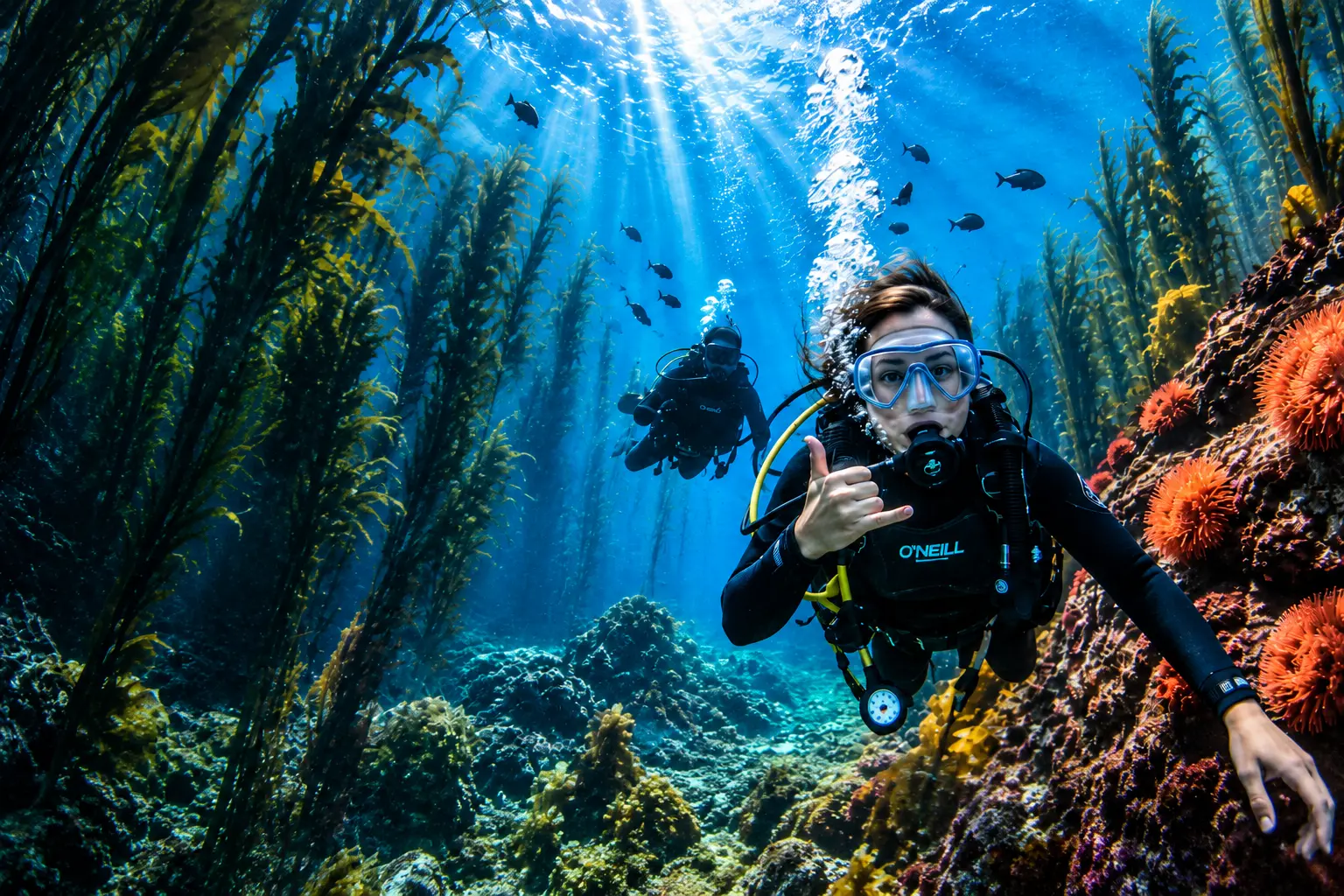
The first adjustment is visual. Unlike a reef, where you look ahead and down, a kelp forest surrounds you: stalks rise from below, fronds drift from above, and the canopy filters light from every angle. It takes a few minutes to calibrate your spatial orientation and start reading the forest’s natural corridors.
Buoyancy control matters more here than in most environments. Dragging along the bottom disturbs the holdfasts, and drifting up into the canopy risks entanglement. The goal is to stay in the mid-water column, moving through the stipes with clear space above and below. Slow, deliberate fin kicks, avoiding large-amplitude strokes that catch fronds, make moving through the forest much easier.
If you do get tangled, stay calm. Kelp is strong but not rigid; gentle, deliberate movement is almost always enough to work yourself free. Backing carefully out of a tangle rather than pulling forward usually frees you faster. Most kelp entanglements are brief and minor; they become problems mainly when a diver panics and thrashes.
For divers who haven’t dived kelp before, going in with a local guide makes a real difference. A guide who knows the forest knows where the natural pathways run, where marine life concentrates on a given day, and how to read surface conditions before committing to the canopy. If you want to explore the kelp with a guide on your first dive here, Dive California runs small-group and private guided dives led by PADI-certified instructors who know this forest well.
Protecting What You’re Diving Through
Giant kelp is more resilient than it looks, but the La Jolla forest still faces pressure. Research published in 2026 by Scripps Institution of Oceanography, just up the coast, documented a steady, long-term decline in the La Jolla and Point Loma kelp beds that goes beyond typical crash-and-recovery cycles. Warming sea temperatures, shifting current patterns, and purple urchin overgrazing in some zones all contribute.
Divers can support this ecosystem by avoiding contact with holdfasts, maintaining good buoyancy so fins don’t disturb the reef substrate, keeping a safe distance from resting marine life, and using reef-safe sunscreen when diving near the canopy. The reserve designation protects the forest legally; divers protect it in practice.
The La Jolla kelp forest is one of the few places in Southern California where you can be genuinely inside a wild ecosystem rather than observing it from a distance. That’s worth treating carefully.
