PADI Advanced Freediver Course
The advanced freediver course is designed to fulfill your personal desire to refine and improve your freediving skills, allowing you to progress slowly while learning how your body performs during deeper dives.
During the course, you will learn how to improve your breath hold time and depth, and advance your buddy / safety skills. You will also gain a deeper understanding of how the ocean impacts your body.
Course Information
What’s Included:
- Course Tuition
- PADI Advanced Freediver eLearning (online study materials)
- PADI Certification Processing Fee
- Open Water Sessions
Course Prerequisites:
- PADI Freediver Certification (or a Level 1 certification from another agency)
- Complete the PADI medical questionnaire with physician sign-off, if needed
- Be at least 15 years old (if you’re under 18, there will be depth/static/dynamic limitations)
Group Size: 4-1 Student-to-Instructor Ratio
We cap our classes at 4 students to maximize safety and personalized guidance.
Friday | Day 1
Classroom Session | 12 PM to 6 PM
Learn advanced freediving principles with PADI eLearning, followed by a classroom session with your instructor.
Location: Ocean Enterprises, Balboa Office Building, 7710 Balboa Ave #101, San Diego, CA 92111

Saturday | Day 2
Pool Training Session | 8 AM to 4 PM
Learn breath hold techniques in a controlled pool setting. Goal: Static apnea for a minimum of 2 minutes, 30 seconds and dynamic apnea of 50 meters/165’ feet.
Location: West Hills High School, 8756 Mast Blvd., Santee, CA 92071

Sunday | Day 3
Open Water Training | 7 AM to 1:30 PM
Practice free immersion and constant weight freedives in the ocean, along with proper buddy procedures. Goal: Constant weight freedives for a minimum of 20 meters/65’ feet (15 meters/50’ feet for freedivers younger than 18).
Location: La Jolla Shores, Kellogg Park, 8277 Camino Del Oro, La Jolla, CA 92037
All locations will be provided in your welcome email/course outline after your booking. Pool and Ocean locations are based on weather or ocean conditions and are subject to change.
Where Does the Advanced Freediver Fit
in the PADI Freediving Path?
PADI freediving certification levels follow a clear progression — each course builds the physical skills, safety knowledge, and depth confidence needed for the next. Here's the full picture.
The starting point. You'll learn your first breath-hold techniques, basic duck dive, and safe buddy procedures in a controlled pool environment — building the confidence to take your skills into open water.
View course →Your first open water certification. This course covers constant weight freediving with fins, static and dynamic apnea, foundational Frenzel equalization, and buddy rescue skills. A lifetime certification — and the required prerequisite for the Advanced course.
View course →This is where depth becomes real. If you've hit the ceiling at 16 meters and want to push to 20 meters and beyond, the Advanced Freediver course is your next move. You'll master advanced Frenzel equalization and reverse packing, experience the free-fall/sink phase, and build the physiological knowledge and safety skills that serious freediving demands — all in a maximum 4:1 class setting at La Jolla.
Book this course →The elite tier. PADI Master Freediver requirements include your Advanced Freediver certification, active CPR, First Aid, and Emergency Oxygen Provider certifications, and a minimum age of 18. You'll develop mouth-fill equalization, FRC diving, and techniques for pushing below residual volume — the closest you'll get to moving through the water like an aquatic mammal.
View course →Already a certified PADI Freediver hitting 12–16 meters? The Advanced Freediver course is your natural next step. The gap between 16m and 20m isn't just physical — it demands better equalization, a deeper understanding of your body under pressure, and more disciplined safety protocols. That's exactly what this course trains.
Book the Advanced Freediver Course →What Does the Advanced Freediver Course Feel Like?
Deeper dives demand a different kind of equalization. Advanced Frenzel technique and reverse packing become essential as pressure increases, requiring precise control of your tongue, throat, and soft palate rather than the volume of air you can hold in your lungs. It’s less about strength and more about discipline, small, deliberate movements replace effort.
There’s a meditative quality to it all. With no bubbles, no regulator noise, and no surface distractions, deeper freediving narrows your focus to breath, body, and water pressure. Many divers say it’s the closest thing to true stillness they’ve experienced.
And then there’s the moment you touch 20 meters on a single breath, turn, and rise back toward the light. It’s quiet, physical proof of what disciplined breath-hold training can do.
Course Skills
- Expand and refine your knowledge of freediving equipment.
- Introduction to dry training and confined water training specific to deeper freediving.
- Classroom session that covers freediving physics and physiology of deeper freediving.
- Introduction to advanced Frenzel equalization & reverse packing.
- Freediving injury prevention.
- Pre-diving breathing, stretching and relaxation techniques including introduction to diaphragmatic stretching.
- Confined water/pool session that focuses on static, dynamic apnea in addition to a freediving rescue skill review as well as an introduction of no-fins dynamic variation.
- Open water/ocean sessions that focus on depth diving, free immersion and constant weight as well as the introduction to the no-fin constant weight variation.
- Learning to freedive with a lanyard and nose clip.
- Experience the free-fall/sink phase.
- Advanced freediving safety training and rescue skills.

Certification Requirements:
- 2:30+ (STA) Static Breath Hold
- 50 m/165′ (DYN) Dynamic with Fins
- 20 m/66′ (CWT) Constant Weight Fins and (FIM) Free Immersion
Course Equipment
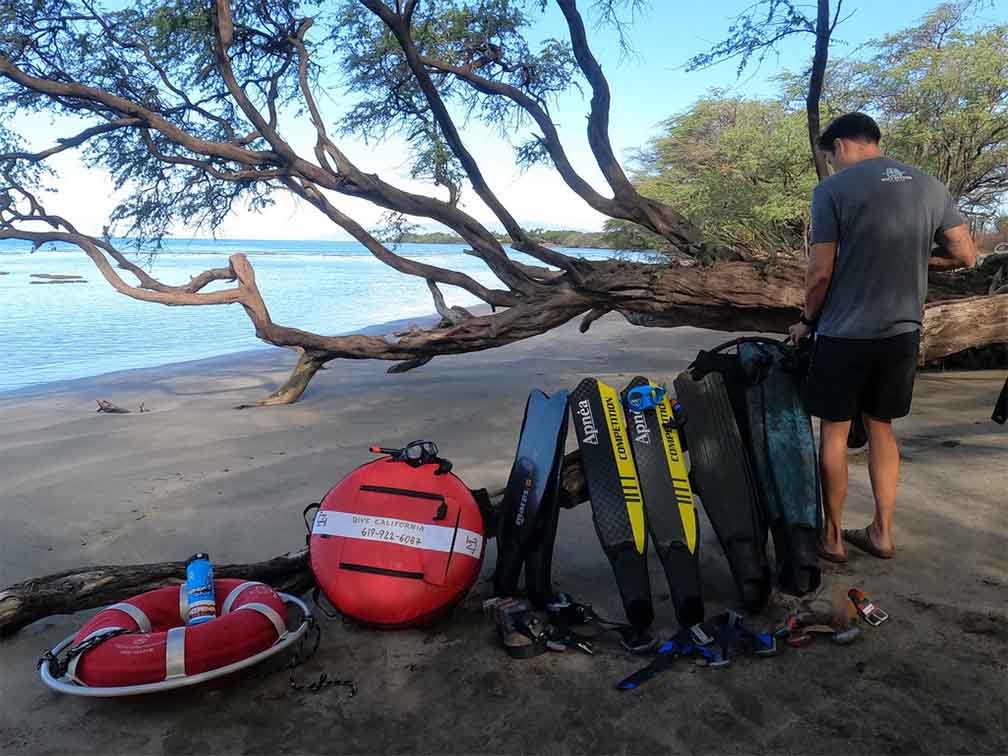
At this level you should already own your personal freediving gear, but if for whatever reason you’re unable to supply your own equipment, you can rent the necessary gear from us for an additional $50.
- Mask: A low volume freediving mask (not mirrored as the instructor needs to be able to see your eyes).
- Snorkel: Simple J-style snorkel.
- Fins: Long blade freediving fins. No scuba or split fins with open heel made to use with boots.
- Wetsuit: Due to San Diego’s colder ocean conditions, we highly recommend a well fitted, 5mm two-piece freediving or spearfishing wetsuit, open-cell with nylon on the outside. For the pool session, a 3/2- or 4/3-mm surf or triathlon wetsuit will be sufficient as the pool is heated.
- Weight Belt: Rubber or Silicone weight belt, preferably Marseillaise style.
- Weights: A variety of 2 and 1lbs weights as they are easier to adjust. We do not recommend 4, 5lbs weight or bigger.
- Freediving Computer: A waterproof timing device that can record time and depth. We will discuss various settings like alarms, meeting a dive buddy at depth, proper surface intervals and others during your live classroom session.
- Safety Lanyard: Required for dives with limited visibility and deeper than 20 meters/66’feet.
FAQs
How long does the advanced freediver course take?
The PADI Advanced Freediver Course runs over 3 days. Day 1 is a 6-hour classroom session (12 PM–6 PM) covering advanced freediving theory. Day 2 is an 8-hour pool training session (8 AM–4 PM) focused on static and dynamic apnea. Day 3 is a 6.5-hour open water session (7 AM–1:30 PM) at La Jolla Shores, where you'll complete your certification dives.
What is the difference between Freediver and Advanced Freediver?
The PADI Freediver Course is the entry-level certification that teaches the fundamentals of static, dynamic, and constant weight freediving. The PADI Advanced Freediver Course builds on those skills, helping certified freedivers extend their breath-hold times, refine equalization and buddy/safety techniques, and safely train for greater depths. A PADI Freediver certification (or equivalent Level 1 certification) is required before enrolling in the Advanced course.
How deep can an advanced freediver go?
To earn your PADI Advanced Freediver certification, you'll need to reach a constant weight (fins) or free immersion depth of 20 meters/66 feet. Freedivers under 18 train to a reduced depth of 15 meters/50 feet. With continued practice after certification, many divers progress beyond these depths, but 20m is the benchmark for this certification level.
What are the prerequisites for the PADI Advanced Freediver Course?
You'll need a PADI Freediver certification (or a Level 1 certification from another recognized freediving agency), completion of the PADI medical questionnaire (with physician sign-off if required), and you must be at least 15 years old. Freedivers under 18 have some depth, static, and dynamic limitations during training.
Can anyone take the PADI Advanced Freediver Course?
You must be a certified PADI Freediver, or have completed a Level 1 course by another internationally recognized freediving certification agency.
How do I prepare for my course?
You will need to complete the PADI Advanced Freediver eLearning course we send you and pass the knowledge reviews and exam. You should also be well rested, hydrated and ready to learn. Also make sure you are not congested, and your equalization is working fine the days prior to the start of the course.
Can I use my own freediving equipment?
Absolutely! You can either use your own gear or use our equipment. Rental gear is an additional $45 for the duration of the course.
What is the group size at Dive California?
We never exceed a 4:1 Instructor-to-Student ratio, to maximize safety and ensure each student receives dedicated instructor attention.
What should I bring to the course?
Any freediving equipment you already own, as well as the required freediving lanyard, appropriate swim wear like a bikini, swimsuit, speedo, jammers, refillable water bottle, towel, and reef safe sunscreen.
Is this a lifetime certification?
Yes! This PADI certification will not expire. We still recommend that you keep improving and practicing your freediving skills regularly.
What is the cancellation / refund policy?
- 72 Hour Cancellation Policy strictly enforced, NO exceptions.
- Less than 7 days' notice, prior to start of the course, you may move into another course slot with a 50% administration fee of the total course cost.
- No refunds are issued if the cancellation notification is received less than 72 hours from the start of the course, or for no-shows.
- No refunds will be issued for any PADI digital eLearning materials, used or unused.
- A full refund is given if the course is cancelled/rescheduled 72 hours prior to the dive date or if the course is cancelled by the instructor due to unforeseen events, adverse weather/ocean condition or unsafe diving conditions.